Welcome to the Holy Women, Holy Men blog! We invite you to read about this commemoration, use the collect and lessons in prayer, whether individually or in corporate worship, then tell us what you think. For more information about this project, click here.
• • •
About this commemoration
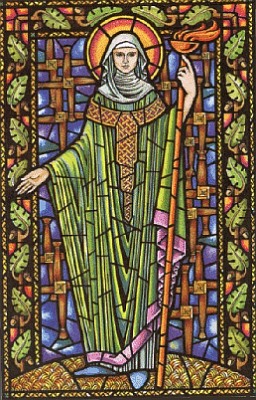
Next to Patrick, Brigid is the most beloved of Irish saints. Born at Fauchart about the middle of the fifth century, she may have met Patrick as a young girl. She was said to be the daughter of Dubhthach, poet laureate of King Loeghaire, and was reared in a Druid household. She decided early in life to dedicate her life to God alone as a Christian. She received a nun’s veil from Bishop Macaile of Westmeath.
Gathering around her a group of women, Brigid, in 470, founded a nunnery at Kildare, a place whose name meant “Church of the Oak.” Here had flourished the cult of a pagan goddess, from which it was said to have derived the sacred fire, which she and her successors maintained. To secure the sacraments, Brigid persuaded the anchorite Conlaed to receive episcopal ordination and to bring his community of monks to Kildare, thus establishing the only known Irish double monastery of men and women. Brigid actively participated in policy- making decisions in Church conventions. One story has it that she received episcopal orders, which may reflect only the fact that she exercised the jurisdictional authority that was customarily wielded by medieval abbesses.
Many stories are told of Brigid’s concern for the poor and needy. When a leper woman asked for milk she was healed also of her infirmity. Two blind men were given their sight. Best known is the tale that tells of Brigid’s taming of a wolf at the request of a local chieftain whose pet dog had been killed accidentally by a peasant. The Gaelic name given to the oyster-catching bird, galle-brigade, attests to her affinity for birds. Her feast day itself, February 1, was long held sacred as Imbolg, the Celtic festival of Spring.
Brigid died about 523 at Kildare, outside whose small cathedral the foundations of her fire-house are still shown to tourists. Her remains are said to have been re-interred, at the time of the Danish invasions of the ninth century, with those of Patrick, at Downpatrick.
Brigid, also known as Bride, was very popular both in Scotland and England, where many churches have been dedicated to her. The best known of them is that church which was designed by Christopher Wren on Fleet Street in London. In Wales, Brigid achieved fame under her Gaelic name Ffraid.

Collects
I Everliving God, we rejoice today in the fellowship of thy blessed servant Brigid, and we give thee thanks for her life of devoted service. Inspire us with life and light, and give us perseverance to serve thee all our days; through Jesus Christ our Lord, who with thee and the Holy Spirit liveth and reigneth, one God, for ever and ever. Amen.
II Everliving God, we rejoice today in the fellowship of your blessed servant Brigid, and we give you thanks for her life of devoted service. Inspire us with life and light, and give us perseverance to serve you all our days; through Jesus Christ our Lord, who with you and the Holy Spirit lives and reigns, one God, for ever and ever. Amen.
Lessons
Judges 4:4–9
1 Corinthians 1:26–31
Matthew 6:25–33
Psalm 138
Preface of a Saint (2)
Text from Holy Women, Holy Men: Celebrating the Saints © 2010 by The Church Pension Fund. Used by permission.
Additional link: http://www.fisheaters.com/customstimeafterepiphany2a.html – includes additional information on Feast of St. Brigid commemorations, including celebration recipes.
• • •
We invite your reflections about this commemoration and its suitability for the official calendar and worship of The Episcopal Church. How did this person’s life witness to the Gospel? How does this person inspire us in Christian life today?
If you’d like to participate in the official online trial use survey, click here. For more information about the survey, click here.
To post a comment, your first and last name and email address are required. Your name will be published; your email address will not. The first time you post, a moderator will need to approve your submission; after that, your comments will appear instantly.