Welcome to the Holy Women, Holy Men blog! We invite you to read about this commemoration, use the collect and lessons in prayer, whether individually or in corporate worship, and then tell us what you think. For more information about this project, click here.
About this commemoration
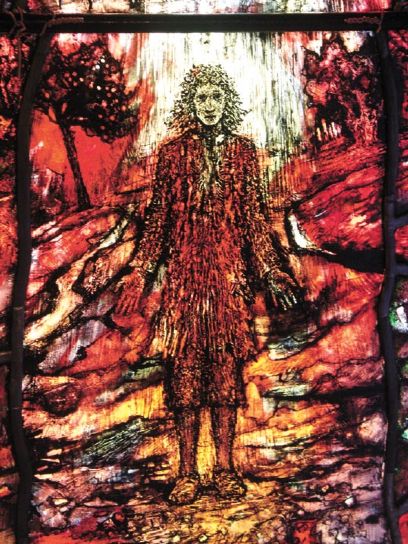 Though not as well known as John Donne or George Herbert, Thomas Traherne was one of the seventeenth century’s most searching, inventive poets and theologians.
Traherne was among about twelve Anglican lyricists dubbed by the rather prosaic Samuel Johnson as “the Metaphysical Poets.” Johnson meant this to imply that their poetry was pretentious and obscure. What he missed was not only their erudition but their subtlety and their profound awareness of the depths of Divine Mystery through which they tried to articulate the Christian Faith in a world which was changing from the sure faith of the Middle Ages to the bewildering maze of conflicting opinion which was the “Modern”.
Born in 1637, the son of a humble shoemaker in Hereford, Traherne went to Oxford thanks to the generosity of a prosperous relative. He was awarded the B.A. in 1656 and later the M.A. and B.D. He was ordained priest in 1660. From 1667 on he was the chaplain to Sir Orlando Bridgeman, Keeper of the Great Seal. At 37 he died in his patron’s house.
Traherne’s poetry was unpublished and unknown until it was found in manuscript in a London bookseller’s stall at the beginning of the twentieth century. In all the Metaphysical Poets we find the attempt, often through startling images and seemingly contradictory metaphors, to express the inter-penetration of the sacred and the profane, the mortal human and the immortal divine, the verities of the new sciences and the eternal verities of God’s revelation in the Incarnation of Jesus Christ. Traherne was particularly taken with the paradox that the naive grandiosity and self-centeredness of a small child was, in fact, a kind of window into the Divine Being. In reading his poetry it is sometimes not clear whether he is speaking of himself as a small child or of the Christ-Child. In fact, he is often inferring both, by which he means us to understand that in the Incarnation, God assumed our humanity and so our humanity is in fact, our blessed access to God.
COLLECT
Creator of wonder and majesty, who didst inspire thy poet Thomas Traherne with mystical insight to see thy glory in the natural world and in the faces of men and women around us: Help us to know thee in thy creation and in our neighbors, and to understand our obligations to both, that we may ever grow into the people thou hast created us to be; through our Savior Jesus Christ, who with thee and the Holy Spirit liveth and reigneth, one God, in everlasting light. Amen.
Creator of wonder and majesty, you inspired your poet Thomas Traherne with mystical insight to see your glory in the natural world and in the faces of men and women around us: Help us to know you in your creation and in our neighbors, and to understand our obligations to both, that we may ever grow into the people you have created us to be; through our Savior Jesus Christ, who with you and the Holy Spirit lives and reigns, one God, in everlasting light. Amen.
Lessons
Jeremiah 20:7–9
Revelation 19:1–5
John 3:1–8
Psalm 119:129–136
Preface of God the FatherText From Holy, Women, Holy Men: Celebrating the Saints © 2010 by The Church Pension Fund. Used by permission.
We invite your reflections about this commemoration and its suitability for the official calendar and worship of The Episcopal Church. How did this person’s life witness to the Gospel? How does this person inspire us in Christian life today?
If you’d like to participate in the official online trial use survey, click here. For more information about the survey, click here.
To post a comment, your first and last name and email address are required. Your name will be published; your email address will not. The first time you post, a moderator will need to approve your submission; after that, your comments will appear automatically